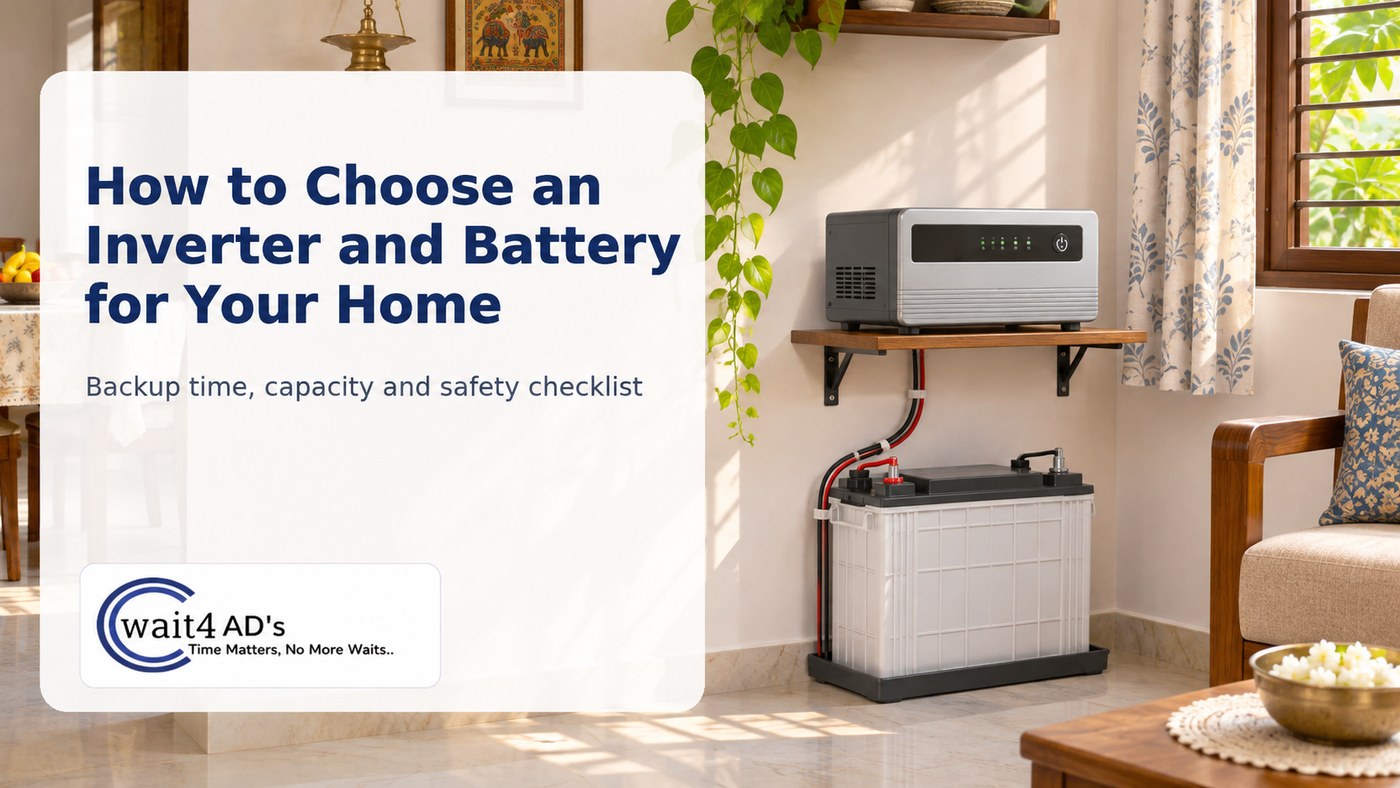
Power cuts can interrupt lights, fans, Wi-Fi, and essential appliances. The right home inverter and battery depend on what you need to keep running, how long you expect backup to last, and what your home’s electrical setup can support. Start with your actual load and usage pattern, then compare products and service—not just the largest VA number or lowest price.
Quick answer: List the appliances you want to power at the same time, check their running and starting requirements, and choose a compatible inverter and battery system with help from a qualified installer. Ask for a written estimate of expected backup time, battery type, installation, warranty, and service costs.
1. What do you need to run during a power cut?
Make a room-by-room list of the devices that must stay on: lights, ceiling fans, router, laptop, television, refrigerator, water pump, or medical equipment. Mark the items that can wait. An inverter designed for a few fans and lights may not be suitable for a large motor or compressor, even if the total running watts look close. Some appliances draw a higher starting current for a short period when their motor starts.
Check the rating plate or manual for each appliance. Note its wattage, input voltage, and any starting or surge requirement the manufacturer provides. If you cannot find the information, ask the appliance manufacturer or a qualified electrician rather than guessing. Decide which devices will actually run together; you may be able to stagger high-load appliances instead of sizing for every item at once.
2. How do you choose inverter capacity?
Compare both the inverter’s VA rating and its real output in watts. VA and watts describe different aspects of electrical load, so the biggest VA figure on a box does not by itself tell you how much useful equipment the unit can support. Check the rated output, overload and surge behaviour, waveform, supported voltage, and the appliances the manufacturer allows you to connect.
Pure sine-wave output is commonly selected for modern electronics and motor-driven appliances, but suitability should be confirmed for the exact device and inverter. Read the product manual and warranty conditions. Avoid adding a heavy appliance later without checking the system capacity and wiring first.
If you plan to back up a refrigerator, pump, or other motor, tell the installer the exact make and model. Ask them to account for starting load, the number of devices that may start together, and any dedicated circuit or transfer arrangement the home needs. A qualified electrician can also confirm whether the installation suits your building’s wiring and supply.
3. How much battery capacity do you need?
Battery capacity is usually shown in ampere-hours (Ah), but an Ah number only makes sense alongside the battery-bank voltage and the conditions under which the rating is specified. A larger Ah rating can support more stored energy at the same voltage, but actual usable energy and runtime depend on the battery chemistry, discharge rate, age, temperature, charging method, and the inverter’s efficiency.
As a rough planning concept, usable battery energy in watt-hours divided by the connected load in watts gives an estimate of runtime. The battery’s usable portion and conversion losses must be included, and manufacturer specifications or installer calculations should set the final expectation. Ask the seller to state the appliances and assumed load behind any backup-time promise. Get the estimate in writing and treat it as an estimate, not a guarantee.
If the power cut lasts longer than the battery’s rated backup, avoid repeatedly draining it beyond the manufacturer’s limit. Deep discharge and unsuitable charging can shorten battery life. Ask how the system signals low battery and what load should be switched off first.
4. Which inverter battery type should you compare?
Lead-acid options include flat-plate and tubular designs; products differ in maintenance needs, operating conditions, rated capacity, and expected service life. Some sealed lead-acid products reduce routine water maintenance, while a flooded battery may require the checks stated in its manual. Keep the battery type and its care requirements in mind when choosing where to install it.
Lithium batteries may be offered in some home backup systems. They use different charging controls and a battery-management system, and they are not automatically interchangeable with a lead-acid battery. Confirm that the inverter supports the exact chemistry, voltage, charging profile, and battery-management communication required by the battery maker. Do not connect a substitute battery based only on matching the voltage.
For every chemistry, check the model number, rated capacity, warranty terms, expected service arrangements, and replacement cost. Ask whether the warranty depends on using a specified inverter, charger, or installation method.
5. Where should the inverter and battery be installed?
Choose a location that is dry, stable, accessible for inspection, and within the limits in the manufacturer’s instructions. Batteries can be heavy, and some types need ventilation or specific clearances. Keep the equipment away from direct heat, water, children, and places where it can be knocked over. Do not block vents or store flammable items beside the system.
Installation involves mains electricity, high current, and battery connections. Use a qualified electrician or authorised installer to select cables, protective devices, earthing, changeover arrangements, and mounting. Do not make live connections or attempt repairs yourself. Ask for a demonstration of normal operation and emergency shutdown, and keep the wiring or installation diagram with the invoice.
6. What is the total cost beyond the purchase price?
Request a quote that separates the inverter, battery, trolley or mounting, cables, protection devices, installation labour, taxes, and any electrical work. Ask what is included in delivery and setup, and what may be charged separately. Compare warranty duration and coverage for the inverter and battery individually; they may have different terms and service channels.
Check whether service is available in your area, how to contact the provider, and how battery replacement is handled. For batteries that need periodic maintenance, ask who performs it and what it costs. For any battery, follow the maker’s instructions on inspections, charging, cleaning, and replacement. Keep your purchase receipt and service records.
7. What should you ask before buying?
- Which exact appliances and starting loads did the capacity recommendation include?
- What is the inverter’s rated output in watts as well as its VA rating?
- What battery chemistry, voltage, capacity, and compatible charging profile are included?
- What load and assumptions support the quoted backup time?
- Which installation, wiring, protection, and ventilation work is included?
- What are the separate warranty terms and local service contacts?
- Can I get the model numbers, manuals, quote, and safety instructions in writing?
Frequently asked questions
Can an inverter run an air conditioner?
It depends on the AC’s running and starting requirements, the inverter’s output and surge capability, and the rest of the connected load. Check the exact models with a qualified installer before purchasing.
How long will a home inverter provide backup?
Runtime depends on battery capacity and chemistry, the connected load, battery condition, temperature, and conversion losses. Ask for a written estimate based on your actual appliances and usage.
Can I replace a lead-acid battery with a lithium battery?
Only if the inverter maker confirms compatibility with the exact battery chemistry, voltage, charging profile, and required controls. Matching voltage alone is not enough.
For additional home and appliance checklists, browse the Wait4Ads blog or visit Wait4Ads.
This is general buying guidance, not an electrical design. Follow the equipment manuals and use a qualified installer for sizing, wiring, installation, and repair.
Powered by Froala Editor