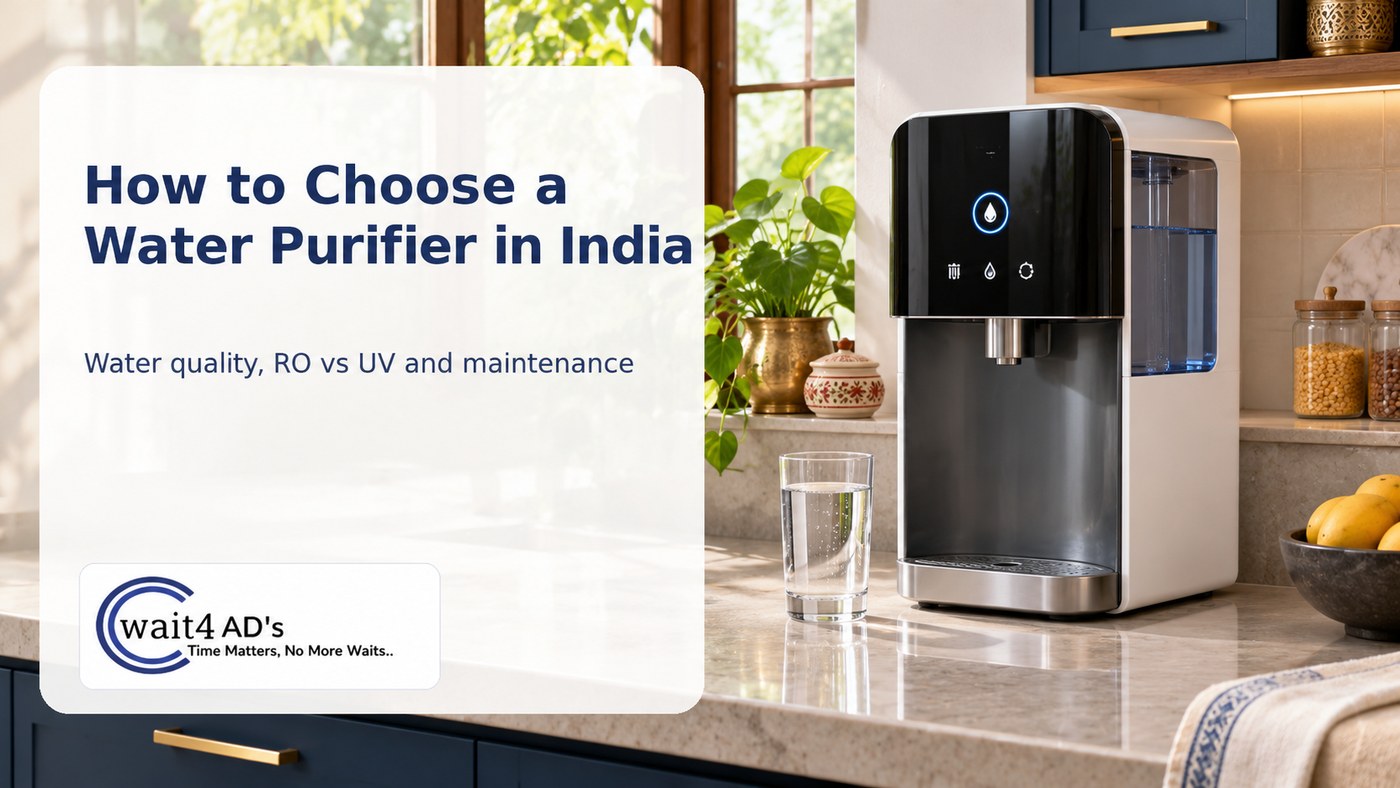
Choosing a water purifier is easier when you begin with the water at your tap, rather than with a brand or a long list of features. In India, source water can vary by locality, season, building, and supply route. A purifier that suits one home may be unnecessary or unsuitable for another. This guide explains what to check before buying, when RO or UV may help, how to compare service costs, and how to maintain the system safely.
Quick answer: Find out what is in your source water, ask for a recent test where possible, and choose a treatment method that addresses those specific concerns. Check the product’s applicable BIS certification, installation requirements, filter replacement schedule, and local service availability before paying.
1. What should you check about your water?
Start by identifying your source: municipal supply, borewell, tanker, or a mix. Ask the housing society or water supplier about recent quality reports. If the source is private, changes seasonally, or has a noticeable change in colour, smell, or taste, consider a laboratory test. Appearance and taste cannot confirm that water is safe; some dissolved substances and microorganisms are not visible.
Depending on the concern, a test may report parameters such as pH, total dissolved solids (TDS), hardness, iron, nitrate, fluoride, or microbiological indicators. A basic TDS meter measures only an estimate of dissolved ionic solids. It does not identify which substances are present, and it does not establish that the water is safe. For a fuller picture, use a competent water testing laboratory and compare results with the applicable drinking-water requirements, including the Bureau of Indian Standards specification IS 10500.
Re-test if your source changes, after a contamination event, or when local authorities advise it. If you suspect an immediate contamination problem, follow local public-health instructions while arranging testing; do not rely on a household purifier as the only response.
2. How do RO, UV, UF and carbon filters differ?
Reverse osmosis (RO) uses a membrane to reduce many dissolved substances as well as particles. It is commonly considered when water testing shows a relevant dissolved-contaminant concern or when the source water characteristics require it. RO systems also produce reject water and need pressure, pre-treatment, and regular service. Ask how much water the model uses and where its reject stream goes.
Ultraviolet (UV) treatment uses UV light to inactivate susceptible microorganisms when water flows through the unit correctly. UV does not remove dissolved salts, metals, or particles, and clear pre-treated water is important for effective treatment. It also needs electricity and timely lamp replacement.
Ultrafiltration (UF) membranes can reduce certain suspended particles and microorganisms, depending on the design, but generally do not remove dissolved salts. Activated carbon can improve certain taste and odour issues and reduce some compounds when the filter is designed and maintained for that purpose. These methods are not interchangeable. Some systems combine stages, but more stages do not automatically mean better water.
Ask the seller to explain, in plain language, which measured water concern each stage is intended to address. For RO-based point-of-use systems, check the applicable BIS requirements and current certification details for the exact model rather than relying on a logo in an advertisement.
3. When should you consider RO?
Consider RO when a qualified test or a credible local supply report points to a dissolved-substance concern that the model is designed and certified to reduce. Do not choose RO solely because a TDS number is high or low without understanding what the number represents. TDS alone is not a complete safety test, and a low reading does not rule out every possible contaminant.
If the water is already treated and its quality is consistently documented, a more complex purifier may add expense, maintenance, and water wastage without solving a known problem. Ask a qualified technician or water-testing lab to interpret results for your source and intended use. Avoid claims that a single household appliance can make every uncertain water source safe.
4. What is the real cost of a purifier?
Compare the total cost over the expected ownership period, not only the purchase price. Request a written estimate for installation, pre-filter, sediment and carbon cartridges, membrane, UV lamp if applicable, service visits, and any annual maintenance plan. Ask which parts are consumables, how often they are typically changed for your water conditions, and what evidence triggers replacement.
Check whether service is available at your address and how quickly the company can respond. Confirm warranty coverage, exclusions, customer-care contact details, and whether original parts are supplied. A low upfront price can become expensive if cartridges are proprietary, service is unavailable, or the unit needs frequent replacement parts.
5. Where will it fit, and what does installation require?
Measure the available wall or counter space and keep room for the tap, power connection, plumbing, and future filter access. Ask the installer to explain the feed-water connection, storage tank capacity, reject-water outlet, and whether additional pre-treatment is recommended for the source. Check whether drilling or changes to a rented home need the owner's approval.
For a shared building, confirm water pressure and whether the unit will be connected to a separate overhead tank or line. Poor installation can cause leaks, low output, or contamination from unclean plumbing. Keep the installation receipt and record the model and serial number.
6. How do you maintain a water purifier?
Follow the model’s manual and the manufacturer’s service schedule. Replace filters and lamps at the stated intervals or when the product’s monitoring system indicates, while taking your local water conditions into account. Ask the technician to explain the work performed and show the replaced parts. Clean external surfaces as directed and do not open electrical or pressurised components yourself.
If the water’s taste, smell, flow, or appearance changes, arrange inspection rather than assuming the purifier is working normally. After a long period without use, follow the manufacturer’s instructions for flushing and sanitising. Keep service records so you can see when parts were changed and plan the next visit.
7. What should you ask before buying?
- What is my source water and what test or report supports this treatment choice?
- Which specific parameters does this exact model claim and is the claim independently certified?
- What is the model's applicable BIS standard and how can I verify its current certification?
- How much water does it use, and what happens to reject water?
- What is the written annual service and replacement cost for my location?
- Who installs and repairs it, and what does the warranty exclude?
- Can I see the manual, model number, service contact, and replacement-part details before paying?
Frequently asked questions
Is a TDS meter enough to choose a water purifier?
No. It gives a limited measurement and does not identify individual substances or check for every microbiological concern. Use an appropriate water test and interpret it with a qualified source.
Is RO better than UV?
They address different concerns. RO can reduce many dissolved substances; UV is intended to inactivate susceptible microorganisms in properly treated flow. Choose according to test results and product certification, not a general claim that one technology is always better.
How often should purifier filters be changed?
Follow the product manual, indicator, and service guidance for your model and water conditions. There is no single interval suitable for every household.
Use this checklist before comparing models, and keep your water test and service receipts together. For more local buying and selling guides, browse the Wait4Ads blog or visit Wait4Ads.
Information is general consumer guidance and does not replace water testing, public-health advice, or the product manual. Standards and certification status can change; verify the current requirements and the exact model before purchase.
Powered by Froala Editor